

Yann LeCun
Sources used: First-hand material and reporting or indirect copies.
The map position is our interpretation of the public statements below. Read the method.
Position, range and evidence details
Preferred pace: 43; stated catastrophic-risk concern: -48. These are layout units, not percentages or rankings.
Pace range: 20 to 75; concern range: -90 to -12. Ranges show alternative editorial interpretations, not statistical confidence intervals.
Evidence clarity: medium. Basis: mixed. Implementation: public-advocacy.
Record status: Published record
What this status means
This is a published Atlas record with no open challenge recorded in this edition. It is not a guarantee that the sources are current or the interpretation is correct.
Status recorded: 2026-09-16. This is separate from the source-reading and actor-review dates.
Publication dates and source age
Sources counted: 4
Newest dated source: 2026
At least one source was published within the 18-month window.
Assessed at this edition's evidence cutoff: 2026-09-16. 18-month boundary: 2025-03-16.
Publication age does not tell us whether a claim is still valid. Reading an old source again does not make its publication date newer. An update date does not establish that the passage we used was updated.
Open on the map Reading notes · Structured record
What this position covers
His personal public views, separate from the policies of Meta and AMI Labs. [1] [2] [3] [4]
Reference this explanation or suggest a correction
Link to this explanation · Suggest a correction · How corrections work
What to keep in mind
He disputes takeover arguments but also raises concerns about unsafe actions and concentrated control. The map position still relies on his 2024 interview; the 2026 material adds context. [1] [2] [3] [4]
Reference this explanation or suggest a correction
Link to this explanation · Suggest a correction · How corrections work
What they say about the pace of AI
In 2024, argues for gradual development with safeguards and broad access. [1]
Find the passage in the source
Open source and risk discussion (1:43:48–1:49:58; 2:08:48–2:24:38)
Reference this explanation or suggest a correction
Link to this explanation · Suggest a correction · How corrections work
What they say about catastrophic risk
In 2024, challenges sudden-takeover scenarios and argues that capabilities and safeguards can improve together. [1]
Find the passage in the source
2:08:48–2:20:24
Reference this explanation or suggest a correction
Link to this explanation · Suggest a correction · How corrections work
Context and qualifications
The Verge reports that he mocked Amodei’s alarm, referring to earlier warnings about GPT-2. The original post was not retrieved. [2]
Find the passage in the source
Yann LeCun response; linked X original inaccessible
Reference this explanation or suggest a correction
Link to this explanation · Suggest a correction · How corrections work
Context and qualifications
In a conversation published in 2026, argues for open research and further conceptual advances beyond scaling current models. [3]
Find the passage in the source
Open-science discussion; PDF pages 57–59
Reference this explanation or suggest a correction
Link to this explanation · Suggest a correction · How corrections work
Context and qualifications
Brown’s account of his April lecture reports a warning: systems acting without predicting consequences can be dangerous. [4]
Find the passage in the source
Opening discussion of actions and consequences
Reference this explanation or suggest a correction
Link to this explanation · Suggest a correction · How corrections work
The wider picture
Favors open AI research and disputes takeover arguments. He also warns about unsafe actions by current systems; his optimism does not mean that every use is safe. [1] [3] [4]
Reference this explanation or suggest a correction
Link to this explanation · Suggest a correction · How corrections work
What his skepticism covers
In his 2024 interview, he expects gradual progress and improving safeguards. He also worries about concentrated control of AI. These are his arguments, not proof that future systems will remain controllable. [1]
Reference this explanation or suggest a correction
Link to this explanation · Suggest a correction · How corrections work
What the 2026 material adds
His Dædalus conversation supports open research. At Brown, he warns about systems acting without predicting consequences. Support for development and concern about deployment can coexist. [3] [4]
Reference this explanation or suggest a correction
Link to this explanation · Suggest a correction · How corrections work
His role and the dates
Dædalus identifies him as AMI Labs’ executive chairman and a NYU professor, with Meta as a former role. The map still uses his 2024 interview for both axes. The newer sources do not provide an overall catastrophic-risk estimate. [3] [1] [4]
Reference this explanation or suggest a correction
Link to this explanation · Suggest a correction · How corrections work
Share this page
https://theaiatlas.org/people/lecun/
Download a share image · Vector image
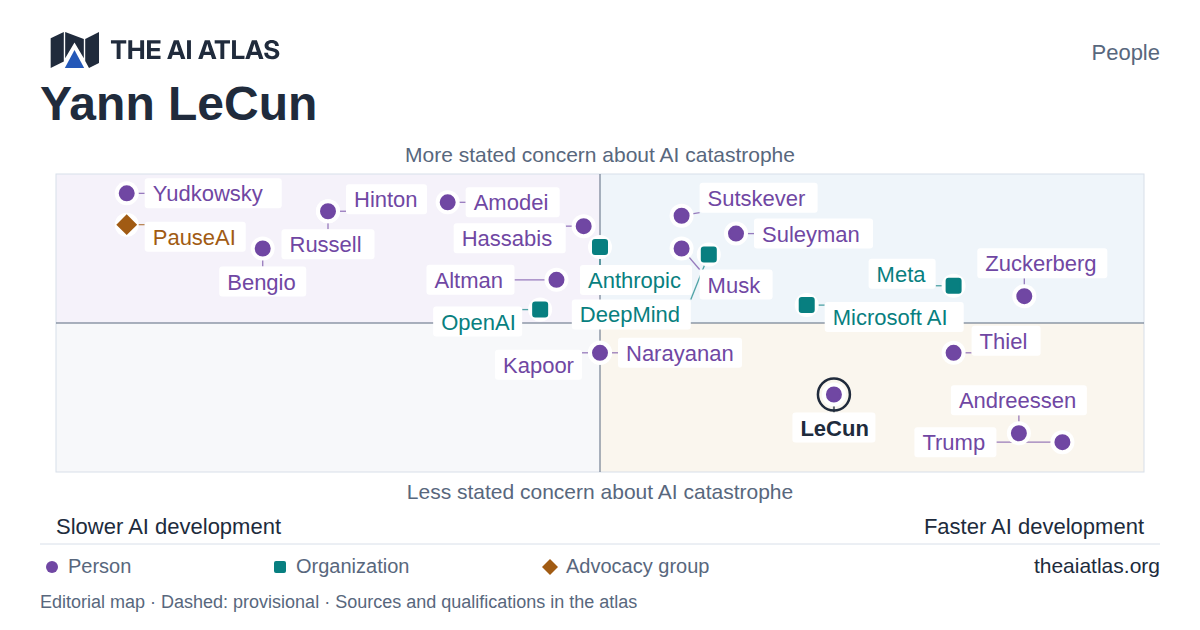
Image previews are summaries. Keep the page link so readers can check the evidence.
Sources and what we read
1. Yann LeCun: Meta AI, Open Source, Limits of LLMs, AGI & the Future of AI, transcript #416
Source is over 18 months old.
Publication dates and source age
Sources counted: 1
Newest dated source: 2024-03-07
Assessed at this edition's evidence cutoff: 2026-09-16. 18-month boundary: 2025-03-16.
Publication age does not tell us whether a claim is still valid. Reading an old source again does not make its publication date newer. An update date does not establish that the passage we used was updated.
What we read: Introduction; Open source and AI and ideology (1:43:48–1:49:58); AI doomers (2:08:48–2:24:38). These sections were reread on 16 September 2026, not the full transcript or recording.
No archived copy verified · Archive check 2026-09-15
First-person interview transcript; transcription errors are possible. The 16 September rereading covered selected sections only. Its arguments date from 2024. The September 2026 response remains separately attributed reporting.
2. What execs and politicians are saying about slowing down AI development
Publication dates and source age
Sources counted: 1
Newest dated source: 2026-09-14
At least one source was published within the 18-month window.
Assessed at this edition's evidence cutoff: 2026-09-16. 18-month boundary: 2025-03-16.
Publication age does not tell us whether a claim is still valid. Reading an old source again does not make its publication date newer. An update date does not establish that the passage we used was updated.
What we read: The article's reporting on Altman, Hassabis, Musk and LeCun, including links to their posts. The original post text was not independently retrieved.
No archived copy verified · Archive check 2026-09-15
Original posts mentioned in this source
These links help trace the reporting. Their original text was not independently retrieved. They are not additional verified sources.
- Sam Altman · X post 2098811563415150910
The linked X page returned HTTP 403. The reporting remains the material read; the original text was not independently retrieved.
No archived copy verified · Archive check 2026-09-15
- Sam Altman · X post 2099348812305473766
The linked X page returned HTTP 403. The reporting remains the material read; the original text was not independently retrieved.
- Sam Altman · X post 2099352016988614852
The linked X page returned HTTP 403. The reporting remains the material read; the original text was not independently retrieved.
- Demis Hassabis · X post 2098909516582490602
The linked X page returned HTTP 403. The reporting remains the material read; the original text was not independently retrieved.
- Elon Musk · X post 2098789109980332057
The linked X page returned HTTP 403. The reporting remains the material read; the original text was not independently retrieved.
No archived copy verified · Archive check 2026-09-15
- Yann LeCun · X post 2099248236074545576
The linked X page returned HTTP 403. The reporting remains the material read; the original text was not independently retrieved.
Article read. Linked X posts could not be fetched independently. Their content is therefore treated as reported, not directly verified.
- Sam Altman · X post 2098811563415150910
3. Learning Abstractions: A Conversation with Yann LeCun
Publication dates and source age
Sources counted: 1
Newest dated source: 2026
At least one source was published within the 18-month window.
Assessed at this edition's evidence cutoff: 2026-09-16. 18-month boundary: 2025-03-16.
Publication age does not tell us whether a claim is still valid. Reading an old source again does not make its publication date newer. An update date does not establish that the passage we used was updated.
What we read: Author biography, discussion of pure LLMs versus added search, and the closing open-science discussion (PDF pages 48–49 and 57–59). Selected passages, not the full interview or cited research.
The issue is labelled Winter/Spring 2026; no exact publication day is assigned. Used for his research advocacy and the author biography, not as proof of technical claims or a new risk estimate.
4. In lecture at Brown, Yann LeCun discusses a new approach to AI
Publication dates and source age
Sources counted: 1
Newest dated source: 2026-04-01
At least one source was published within the 18-month window.
Assessed at this edition's evidence cutoff: 2026-09-16. 18-month boundary: 2025-03-16.
Publication age does not tell us whether a claim is still valid. Reading an old source again does not make its publication date newer. An update date does not establish that the passage we used was updated.
What we read: The article’s lecture summary, especially its opening quotations about actions and consequences. The linked funding report and full lecture were not reviewed.
Read the host university’s account of its lecture. Quotations are reported by Brown; the full lecture recording was not reviewed. Used for his expressed warning about actions and consequences, not independent verification of model capabilities.
Edition and machine-readable evidence
Content version 0.22.0. Evidence cutoff 2026-09-16; this does not mean every source was read on that day.
Pinned complete dataset · Complete evidence page · Agent consumption guide