

Mustafa Suleyman
Sources used: First-hand material.
The map position is our interpretation of the public statements below. Read the method.
Position, range and evidence details
Preferred pace: 25; stated catastrophic-risk concern: 60. These are layout units, not percentages or rankings.
Pace range: -15 to 60; concern range: 30 to 85. Ranges show alternative editorial interpretations, not statistical confidence intervals.
Evidence clarity: medium. Basis: primary. Implementation: public-advocacy.
Open on the map Reading notes · Structured record
What this position covers
Personal advocacy for advanced-model research with limits on autonomy and loss of control. [1] [2]
Reference this explanation or suggest a correction
Link to this explanation · Suggest a correction · How corrections work
What to keep in mind
Limits on autonomy do not establish a general capability slowdown. He says implementation of the new code begins after consultation. [1] [2]
Reference this explanation or suggest a correction
Link to this explanation · Suggest a correction · How corrections work
What they say about the pace of AI
Supports advanced AI research while prioritizing controllability over unrestricted autonomy. [1]
Find the passage in the source
A humanist future; Towards humanist superintelligence
Reference this explanation or suggest a correction
Link to this explanation · Suggest a correction · How corrections work
What they say about the pace of AI
Says he will accept less autonomy to preserve human control. [2]
Find the passage in the source
Paragraph beginning: We want to create incredible AI
Reference this explanation or suggest a correction
Link to this explanation · Suggest a correction · How corrections work
What they say about catastrophic risk
Questions how people could continually contain and control self-improving superintelligence. [1]
Find the passage in the source
Containment is necessary; The purpose of technology
Reference this explanation or suggest a correction
Link to this explanation · Suggest a correction · How corrections work
Context and qualifications
The code is a consultation draft; he places implementation after the final draft. [2]
Find the passage in the source
Paragraph beginning: Once we have the final post-consultation draft
Reference this explanation or suggest a correction
Link to this explanation · Suggest a correction · How corrections work
The wider picture
Supports advanced-model research, but accepts autonomy limits to retain human control; the new code awaits implementation. [1] [2]
Reference this explanation or suggest a correction
Link to this explanation · Suggest a correction · How corrections work
Personal position and company process
His September essay sets out his priorities for training and operating models. This personal record is separate from Microsoft AI’s institutional commitments. [2]
Reference this explanation or suggest a correction
Link to this explanation · Suggest a correction · How corrections work
Share this page
https://theaiatlas.org/people/suleyman/
Download a share image · Vector image
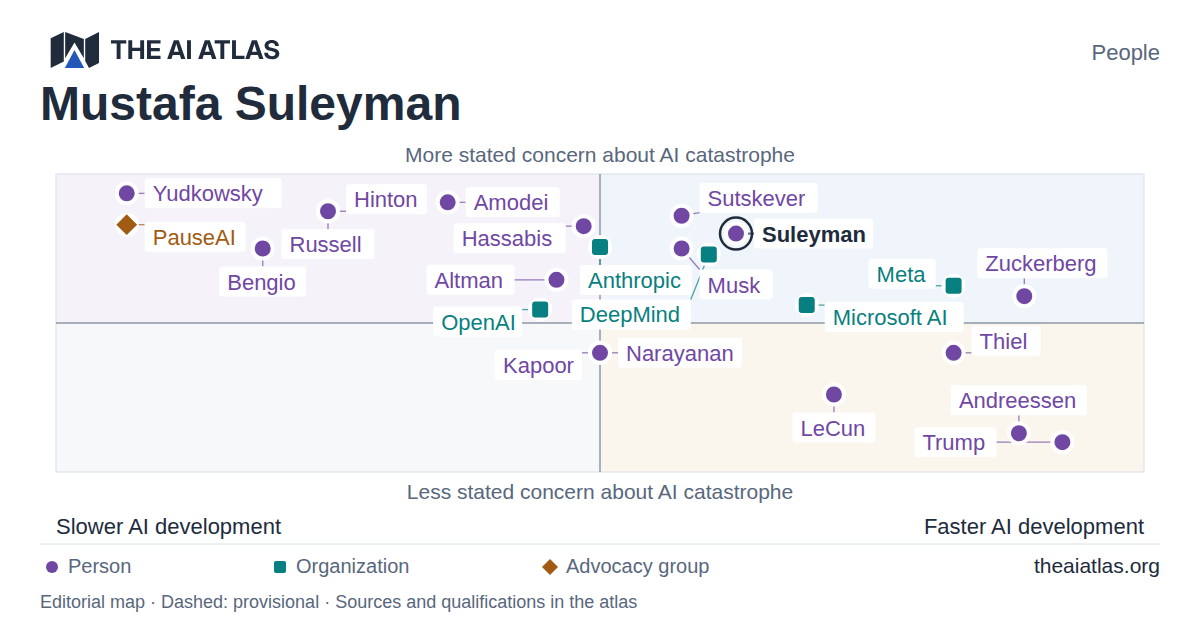
Image previews are summaries. Keep the page link so readers can check the evidence.
Sources and what we read
1. Towards Humanist Superintelligence
Read the personal-site essay, including Containment is necessary and A safer superintelligence. This longer version is dated November 7; Microsoft’s shorter article is dated November 6. Claims about medical performance and future benefits are not adopted.
2. The Humanist AI Code of Conduct
Read the complete personal essay from the original HTML with Python urllib after web retrieval failed. The page displays 15 September 2026. Used for stated control limits and future implementation; incident descriptions and consciousness claims are not independently established.
Edition and machine-readable evidence
Content version 0.19.0. Evidence cutoff 2026-09-15; this does not mean every source was read on that day.
Pinned complete dataset · Complete evidence page · Agent consumption guide