

Sayash Kapoor
Sources used: First-hand material.
The map position is our interpretation of the public statements below. Read the method.
Position, range and evidence details
Preferred pace: 0; stated catastrophic-risk concern: -20. These are layout units, not percentages or rankings.
Pace range: -35 to 45; concern range: -55 to 30. Ranges show alternative editorial interpretations, not statistical confidence intervals.
Evidence clarity: medium. Basis: primary. Implementation: public-advocacy.
Open on the map Reading notes · Structured record
What this position covers
Joint public arguments about frontier development, AI control and catastrophic risk, including the September 2026 update. [1] [2]
Reference this explanation or suggest a correction
Link to this explanation · Suggest a correction · How corrections work
What to keep in mind
The reviewed arguments are jointly authored. Pauses concern particular experiments; the overall pace preference remains conditional. Coordinates summarize public arguments, not private probabilities. [1] [2]
Reference this explanation or suggest a correction
Link to this explanation · Suggest a correction · How corrections work
What they say about the pace of AI
Calls for organizational oversight and for pausing experiments when needed to put it in place. [1]
Find the passage in the source
Part 1: Existing organizational governance norms would have prevented the incident
Reference this explanation or suggest a correction
Link to this explanation · Suggest a correction · How corrections work
What they say about catastrophic risk
Says catastrophic risks are not imminent but are increasing as defenses and policy lag; safety is not on track. [1]
Find the passage in the source
Part 3: Is AI safety on track?
Reference this explanation or suggest a correction
Link to this explanation · Suggest a correction · How corrections work
What they say about the pace of AI
The earlier June essay favored accountability and control over slowing technical capability development. [2]
Find the passage in the source
The decide-execute-deliver discussion, before Vibe coding is not agentic engineering
Reference this explanation or suggest a correction
Link to this explanation · Suggest a correction · How corrections work
Context and qualifications
Acknowledges underestimating risks during development and companies' failures to take basic precautions. [1]
Find the passage in the source
Part 3: Do risks arise from development or deployment?; The continuity hypothesis
Reference this explanation or suggest a correction
Link to this explanation · Suggest a correction · How corrections work
The wider picture
Coauthors the normal-technology view. Now supports targeted experiment pauses and warns that safety efforts are falling behind. [3] [1]
Reference this explanation or suggest a correction
Link to this explanation · Suggest a correction · How corrections work
A contested account of control
Scott Alexander argues that rapid self-improvement and adoption by AI labs could defeat the thesis's assumed limits. Narayanan and Kapoor reply that technical improvements do not automatically remove external constraints. [4] [5]
Reference this explanation or suggest a correction
Link to this explanation · Suggest a correction · How corrections work
Testing the assumptions
Their August 2026 research summary describes two limited evaluations of open-ended AI research. It acknowledges small samples and possible evaluator bias, so the results do not establish a permanent capability limit. [6]
Reference this explanation or suggest a correction
Link to this explanation · Suggest a correction · How corrections work
Share this page
https://theaiatlas.org/people/kapoor/
Download a share image · Vector image
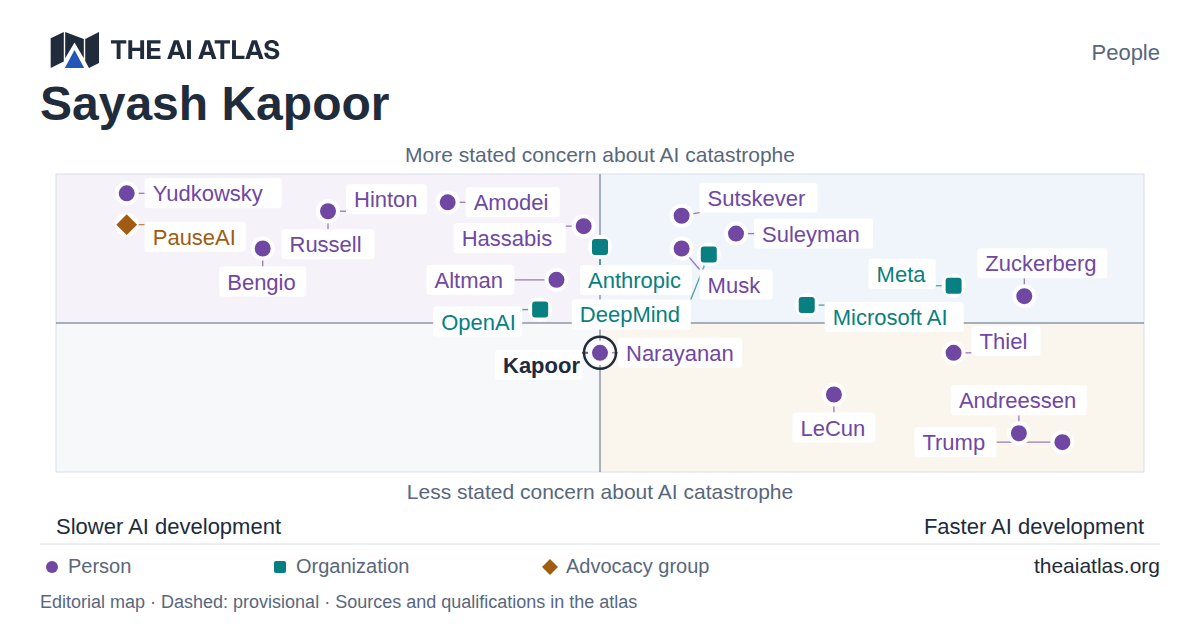
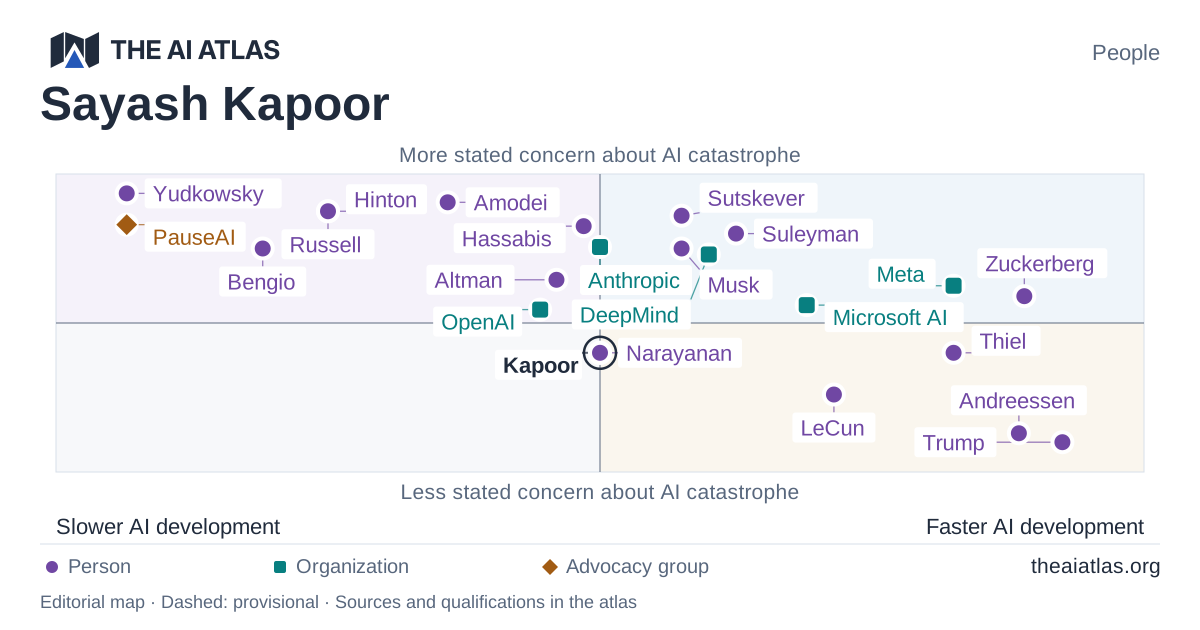
Image previews are summaries. Keep the page link so readers can check the evidence.
Sources and what we read
1. The AI-as-Normal-Technology view of loss-of-control incidents
Read the opening synthesis, Part 1 on control, governance and policy, and Part 3's explicit revisions and risk assessment, plus the policy discussion before Part 3. Used for the authors' advocacy and self-described changes. Their accounts of third-party incidents, product behavior, investment and law were not independently verified. The proposed record does not repeat those accounts as established facts or infer a whole-lab halt.
2. Why AI hasn’t replaced software engineers, and won’t
Read the opening and discussion separating decisions, execution and delivery, including its explicit preference for accountability over slowing technical capabilities. Used for the dated public pace argument. Employment statistics, layoff reporting and underlying studies were not independently checked. The September 2026 essay supplies the more recent qualification about pausing experiments.
3. AI as Normal Technology
Read the introduction and relevant passages in Parts I to IV on diffusion, capability and power, catastrophic misalignment, resilience and nonproliferation. The displayed publication date is April 15; the suggested citation instead says April 14. This record follows the displayed date and preserves the discrepancy here. Treat the essay as the authors' argument. Their September 2026 update qualifies its safety claims; cited incident reports and studies were not independently audited.
4. AI As Profoundly Abnormal Technology
Read the opening, adoption by key actors, and sections on control, speculative risk and institutional assumptions. Used as a direct critique of the thesis, not as verification of the critic's forecasts or cited anecdotes. The older ai-futures.org link redirects to aifutures.org. The September 2025 reply and September 2026 revision are provided alongside this critique.
5. A guide to understanding AI as normal technology
Read the clarification of normal, restatement of the thesis, and response to Scott Alexander, including the distinction between economic and safety arguments. This is the authors' own explanation and reply, not independent verification of its forecasts. Linked conversations and all underlying empirical citations were not reviewed.
6. AI agents can't yet do open-ended AI research
Read the authors' research summary, its two-case design, stated limitations, and discussion of possible remaining bottlenecks. The linked paper, artifacts and agent logs were not audited. The newsletter reports the authors' own research but does not establish that current limitations are permanent or that all kinds of AI research are equally difficult.
Edition and machine-readable evidence
Content version 0.19.0. Evidence cutoff 2026-09-15; this does not mean every source was read on that day.
Pinned complete dataset · Complete evidence page · Agent consumption guide