

Geoffrey Hinton
Sources used: First-hand material and reporting or indirect copies.
The map position is our interpretation of the public statements below. Read the method.
Position, range and evidence details
Preferred pace: -50; stated catastrophic-risk concern: 75. These are layout units, not percentages or rankings.
Pace range: -80 to -15; concern range: 50 to 95. Ranges show alternative editorial interpretations, not statistical confidence intervals.
Evidence clarity: medium. Basis: mixed. Implementation: public-advocacy.
Open on the map Reading notes · Structured record
What this position covers
Conditional controls on exceptionally capable AI in a coauthored policy paper. [1] [2]
Reference this explanation or suggest a correction
Link to this explanation · Suggest a correction · How corrections work
What to keep in mind
The proposal is collective and dated. Its control-risk warning is not a probability estimate or a claim that every kind of AI should stop. [1] [2]
Reference this explanation or suggest a correction
Link to this explanation · Suggest a correction · How corrections work
What they say about the pace of AI
Coauthors a call for conditional development halts when dangerous capabilities emerge. [1]
Find the passage in the source
Mitigation
Reference this explanation or suggest a correction
Link to this explanation · Suggest a correction · How corrections work
What they say about catastrophic risk
Coauthors a warning about irreversible loss of control and human extinction. [1]
Find the passage in the source
Societal-scale risks
Reference this explanation or suggest a correction
Link to this explanation · Suggest a correction · How corrections work
Context and qualifications
The interview publisher reports continued concern about humans losing control. [2]
Find the passage in the source
December 2025 episode summary
Reference this explanation or suggest a correction
Link to this explanation · Suggest a correction · How corrections work
The wider picture
Advocates conditional restraints on highly capable AI and warns about losing control. [1] [2]
Reference this explanation or suggest a correction
Link to this explanation · Suggest a correction · How corrections work
Reading the placement
This point summarizes the coauthored proposal; its range allows different readings. [1]
Reference this explanation or suggest a correction
Link to this explanation · Suggest a correction · How corrections work
Newer context
The December 2025 publisher summary describes his concern about control. His proposed protective instincts are an idea, not a demonstrated safeguard. [2]
Reference this explanation or suggest a correction
Link to this explanation · Suggest a correction · How corrections work
Share this page
https://theaiatlas.org/people/hinton/
Download a share image · Vector image
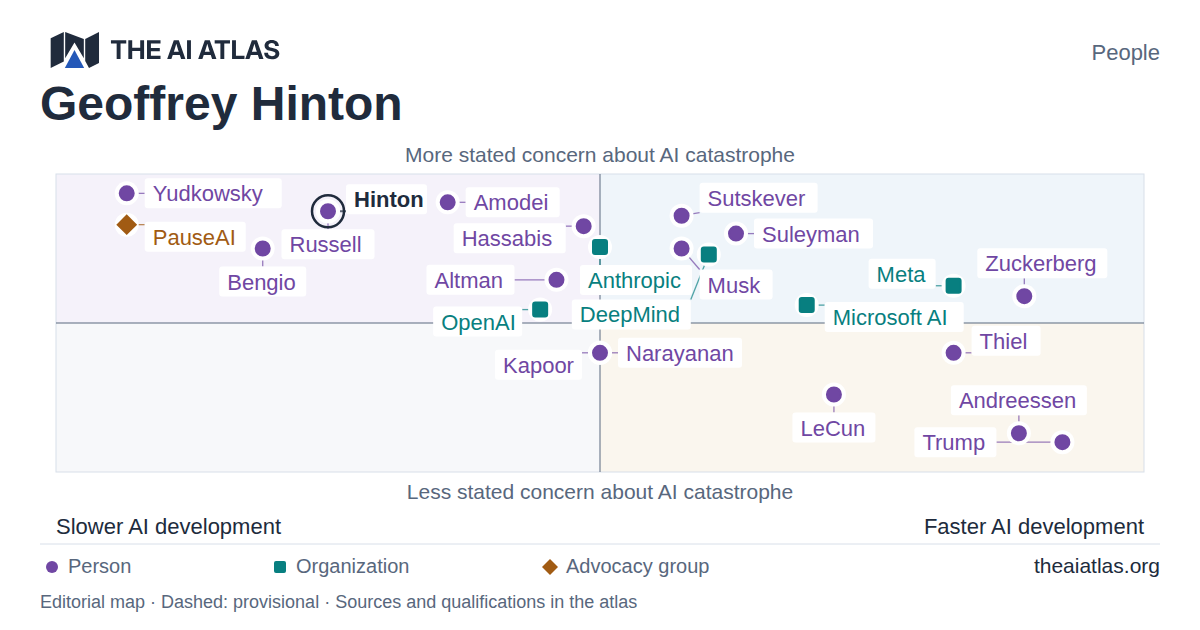
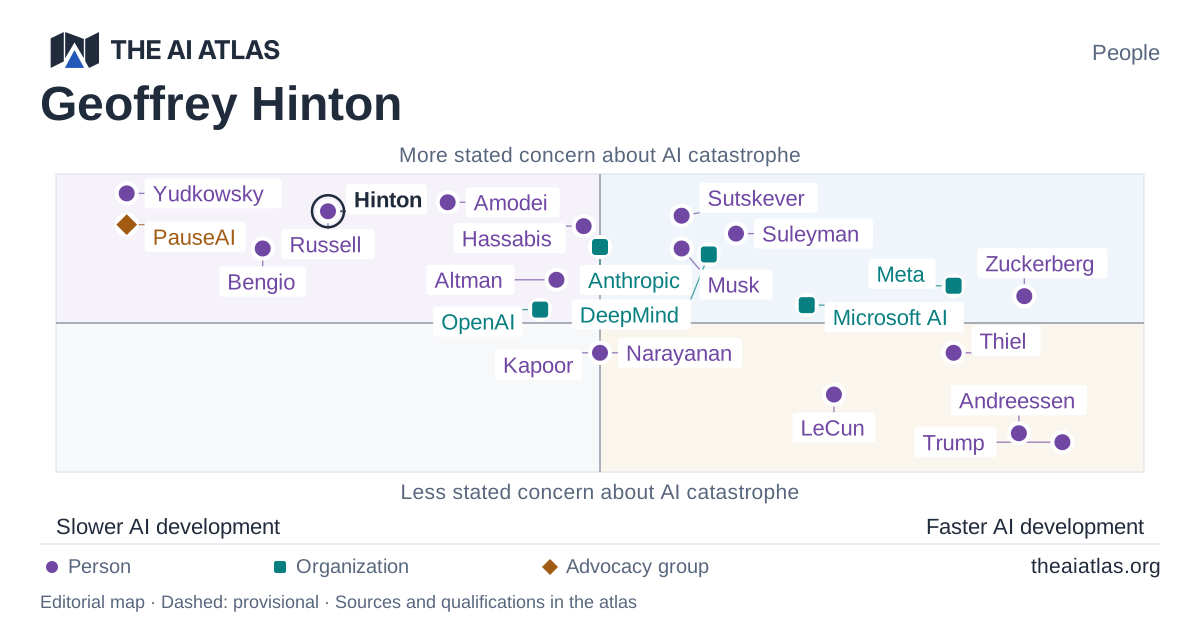
Image previews are summaries. Keep the page link so readers can check the evidence.
Sources and what we read
1. Managing extreme AI risks amid rapid progress (version 3)
Read authors, societal-scale risks and governance/mitigation sections of version 3. Coauthorship supports a shared proposal, not identical personal beliefs or a present-day forecast.
2. The human cost of AI, with Geoffrey Hinton
Read the interview publisher's summary and attributed control-risk quotation. The full audio/transcript was not reviewed; this record is reporting, not direct verification of every interview claim.
Edition and machine-readable evidence
Content version 0.19.0. Evidence cutoff 2026-09-15; this does not mean every source was read on that day.
Pinned complete dataset · Complete evidence page · Agent consumption guide